"This permanent puberty, that's the core, we have to preserve it!"
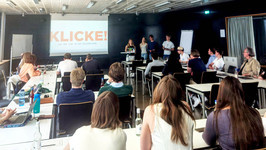
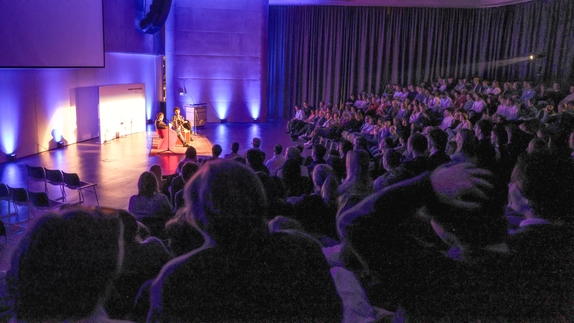
The "Stunde Null" event was designed to motivate the student body at ZU. Lisa Montigel and Arved Friese on the power of community and the potential of empty spaces.
To put it bluntly, where did the idea for Stunde Null come from?
Arved Friese: I had a homework assignment in one of Prof. Jan Söffner's courses with a cultural studies question and wanted to look at the initiative landscape at ZU for it. We found out that the current situation was no longer the same as we knew it from old stories or as it was supposed to have been before Corona. Together with other students, we started discussing what makes the initiative landscape what it is, what makes it special and why it might no longer be lived the way it used to be. This led to the development of a real movement that focused very strongly on student engagement. The team with whom we later produced the video also emerged from this movement. When it came to the question of how we could implement everything we wanted, Lisa came into play.
Lisa Montigel: The second half of the story begins in a course with Prof. Maren Lehmann. For a methods course, we examined the spirit of ZU. The questions were: What is meant by the word ZU spirit? What is behind it? What do we mean when we talk about spirit? Who means what by this term? Spurred on by this, I later took up the post of student senator. Just two or three months later, we realized that we both had the same idea in mind: to awaken people and revive student engagement. We then combined our ideas and developed the beginnings of Stunde Null. Always with the goal: something has to happen soon. The right time was and always is: NOW.
Arved Friese: There was also another piece of work with Julia Hügler, which was about how ZU is generally positioned at the moment. It was a lot about numbers and we realized that there are so many little things that need to be addressed. It was mainly about cultural issues that we can only solve as a community. For example, the question of what our community on campus should actually look like. How can we as a community be attractive to new students again? You can't just decide something like that top-down, it has to come from the community itself. The zero hour should set the starting point for the community; for staff, researchers and students together: Now we are shaping our future together.
The term "zero hour" symbolizes the new beginning after the Second World War. Did you deliberately choose this strong term?
Lisa: In the beginning, we always talked about a bang. So, it needs a bang, it needs a jolt, it needs a turning point, it needs something that makes a difference, otherwise we'll carry on as before. We didn't want zero hour to be understood in a political or previous context! That's why we opted for the subtext "Realistic utopias".
What should follow from "zero hour"
In any case, it is about a beginning. What should follow from this?
Arved Friese: In the best case scenario, a wave of motivation will follow. If something bothers you, people usually just talk about it. We have observed that. For everyone, whether students, employees or researchers. We want people to become active again when something bothers them and then simply change it themselves. You have to set something in motion, take the initiative, get involved in order to change things the way you actually want them to be. But it's not about saying: I see a problem here and this is my solution. It's about saying: there's a problem here and let's work together to find a solution. We want to focus more on the solutions and less on the problems in future.
Lisa Montigel: After all, the historic zero hour was also about community spirit: let's tackle things together. We deliberately didn't say: Arved Friese and Lisa Montigel invite you to the zero hour, but we decided to invite you anonymously and from the middle. We wanted to avoid inviting people in the name of the student body so that no one would feel misrepresented. But in the end, it's about all of us!
Arved Friese: Basically, the zero hour was also simply supposed to be a collection of all the ideas from the students that we've picked up over the last two years and which are sometimes little heard. The only thing we did was to organize the whole thing so that people could see what we actually have going on - what we can do if we want to. And I think that's why Zero Hour was so successful, because it reflected the overall mood and many people were able to find themselves in this energy.
One of the many ideas was to produce a new image video that shows the perspective of the student initiatives. How did that come about?
Arved Friese: The idea came about a year ago. We wanted to use the knowledge we gained from the marketing and finance courses we attended to create something that would better represent us as students. Together with Professor Martin Fritze, we used the last 15 minutes of the marketing course to create a ZU video that combines the theory of the course with the practice of film production. A group of students first collected and analyzed data about ZU. The results of our survey show that students value commitment, dynamism, community and this pioneering spirit the most. Campus life is also part of what defines ZU for us. Prof. Christian Opitz and Prof. Matthias Weiß and around 80 students assisted with the filming. The recipe for success for this video is that everyone worked together: Students, researchers and administrative staff. That was exactly what we were always talking about.
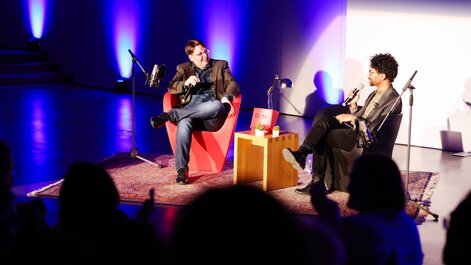
Once again about the "Stunde Null" event: two alumni were there, Frieder Kümmerer and Ferdinand Wintermantel, and talked about their own time ten years ago. The problems and thoughts that occupied them sounded identical to the situation today, don't you think?
Lisa: Yes, 100 percent. Little has changed because I think it's also part of the university's concept that there's an empty space that you have to want to fill. If a work of art is to be placed somewhere, an initiative is missing or a chalkboard wall seems too empty; who takes care of it? The idea of ZU is not that someone does it for me, but that I do it myself, that I learn to create myself. And it is in this empty space that our culture of engagement and, from time to time, the pioneering spirit of our university is born.
Arved Friese: That's exactly what made it so exciting to talk to Frieder and Ferdi, that the very same things were already a topic ten years ago. And I think that's also the headline of the whole event - perhaps also of the whole ZU - just do it, tackle the problems and try it out. It's always the same. Trial and error. You can always fail, but you will learn from it. You can find new solutions again. It takes courage to take risks and courage to fail. Frieder and Ferdi have shown that it can still work!
Lisa Montigel: And that's also the point for me: ZU must not want to grow up! Because that creates the urge for pretentious straightforwardness. This permanent puerility that we have here must be preserved. And now also in anticipation of the future, so to speak, with a view to the eternity of this interview: ZU will certainly come to the point again where there is a crisis, where we once again discuss the fundamental issues. But these questions, these small crises, always create something new or remind us of the old. At least I believe that this empty space is needed to create the desire to fill the empty space.
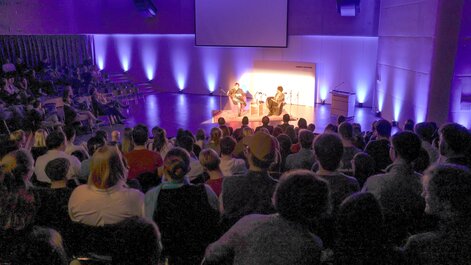
What is your message or your call or your impulse to the community now?
Arved Friese: Just do it.
Lisa Montigel: Just do it, do it yourself, do it now. And above all, do it together!
Arved Friese: People often ask for an explanation, where should I start? What is the first step? And that's exactly what's difficult. I think it's just a matter of really living this simple-sounding sentence and simply getting started. To let yourself fall into the risk. Somehow. It's best to talk about it with others. If I have an idea for something, there are bound to be at least two or three other people at ZU who share this idea. Get together, talk about it and these conversations will lead to approaches on how to realize these ideas. And before you know it, you've practically founded an initiative. That shouldn't be the goal, it doesn't have to be an association. It is perhaps just the joint creation of a shared idea, a shared vision, which you then bring to life together. And the journey, that's the initiative at the end.
Lisa Montigel: Most of us study at ZU for three or four years. That's a special time! Most of us are between 18 and 24 years old and during this time you can implement and achieve so many great things that will stay with you for the rest of your life - in a beautiful way! Just like Frieder and Ferdinand remembered at hour 0. It's not about setting up the next banger initiatives. But above all, it's about pursuing the things that you find interesting, that excite you, and not letting these ideas lie dormant. Talk to people about things that move you, get together, united by interests. Just do it! And because sometimes it's really hard to do it alone: just do it together! And let yourself fall into the risk. If you do something out of curiosity and with fun and perseverance, failure is almost impossible. That's why we're at ZU!
Thank you very much for the interview.
More articles
 06/17/2025ScienceStudent research
The big performance - how the Student Research Day went
At the student research presentation day, many projects looked at how modernity is shaped by representations.- 10/14/2026ScienceThe future of multilateralism
“International organizations rarely die—they are hollowed out.”
How the international order is changing amid growing autocratic influence, and whether multilateralism still has a future: An interview with Professor Dr. Maria J. Debre.  09/21/2026ScienceThree Questions for Simon Koschut
Security. Europe. Responsibility.
How Europe's security order is changing, what role transatlantic relations play in this process, and what responsibilities academia and universities bear in a new security landscape. 07/16/2026ScienceThree Questions for Anja Achtziger
More Than Just Studying. Motivating. Making Decisions. Taking Responsibility.
Why Zeppelin University emphasizes judgment, responsibility, and interdisciplinary thinking, and why these skills are more important than ever before.