
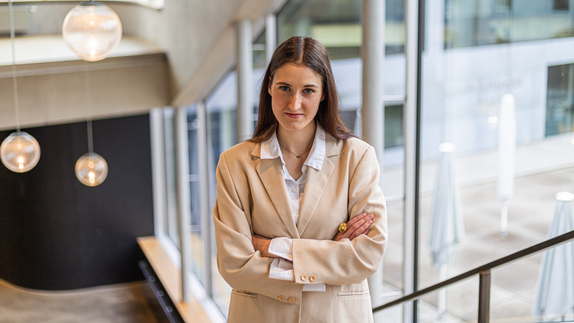
Diana’s Path from Ukraine to Zeppelin University
From Kyiv to Zeppelin University: Diana Perinski tells us her story. A story of resilience, cultural adaptation, and the life-changing impact a scholarship can have.
Why don’t you start by telling me who you are?
Diana: My name is Diana, and I’m from Kyiv, the capital of Ukraine. After graduating from high school, I went to university in another city, which, I think, is called "Lemberg" in German. That was my first time moving away from my family. At first, I was really upset about it, but eventually, I got excited. What else…? I’m 20 years old, have two siblings, and two pets. We’re a big family, and there’s always something fun and interesting happening.
What are you studying here, and how do you like it so far?
Diana: I’m studying Management, Economics, and Social Science. It’s a new program that was introduced this year. It’s been really nice—exactly what I expected, which makes me very happy. It’s neither too hard nor too easy. I like the university, the campuses, the people, and the professors. Everything is just really cool.
Why did you choose Zeppelin University, and why Germany in general?
Diana: Those are two different topics. First, about moving to Germany—we came here because of the war. I moved with my family, which made it much easier than moving alone. We also have family here who supported us a lot with accommodation and settling in. Their kindness has been incredible. We moved in 2022 and decided to stay for now. My mom started looking into universities for me because we were not sure if I could keep continuing studying at my university. She discovered Zeppelin University on Facebook and became very enthusiastic about it. I didn't really consider going to university that year because I was quite stressed, and I wanted to have some time to adjust and understand if I even wanted to stay in Germany. But later, I remembered her excitement, I checked the website again, and I was like, wow, that's really nice.
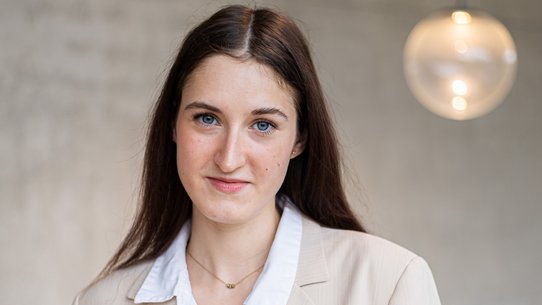
How do you like the student life here? Is it comparable to your previous universities?
Diana: It’s hard to compare because I’ve studied at three universities, each very different. My first university in Ukraine was stressful at first because I didn’t want to move away, and just as I was adapting, the war started. So I was like, okay, let's move on. Then I did an exchange semester at the University of Notre Dame in the USA. That was really nice, the biggest experience of student life that I ever had in my life. Here at ZU, I'd say the university and the students organizations are doing a lot of nice things, but I can't say that much about Friedrichshafen yet.
How did you choose your field of study, and what interests you about it?
Diana: I studied sociology at my first university, which I found interesting, but I knew, that I don't want to do that as a career. I’ve always been interested in social sciences, psychology, for example, so I really like that the third part of MES is social sciences. I also studied economics in high school and was debating it for my studies at university. This program combines those interests, plus management, which I had been curious about. I also liked the focus on sustainability, which is an important aspect of the curriculum.
Diana Perinski plant nicht mehr so weit in die Zukunft wie früher
Do you have any career goals in mind after university?
Diana: I have dreams, though I’m not sure how to achieve them yet. I’d love to work in the fashion industry, particularly in the fashion business. I also really like the focus on entrepreneurship here at ZU and that everyone is motivated to find something themselves. I always wanted to create something by myself, and here I can learn how to do it in a sustainable way. So I really like that I can gain so much from this place, not only from my classes. We also have a lot of workshops here, which I didn’t have at my previous universities. I think that is a really nice part.
Does your family plan to stay in Germany long-term? What about you?
Diana: Nowadays, I try not to plan anything that far in the future. I used to plan a lot. I used to plan how I'm going to graduate, find a job, get married, and all that. But then I kind of learned not to plan anything that far in advance because you can just wake up and your life changes. For now, my parents want my siblings and me to graduate here and maybe work in Germany. I’ll definitely stay for my bachelor’s degree and likely a master’s. Beyond that, who knows how the future will turn out?
Have you faced any challenges at ZU or in Germany in general?
Diana: It was definitely a cultural shock because even though we're all in Europe, and it seems like we are really close, there are a lot of things that are different in Germany in comparison to Ukraine. People are not behaving in the same ways I’m used to, and especially the bureaucracy has been challenging. It was nice that I knew German at a certain level, it wasn't perfect, but I could at least understand something, since I learned it in school. Still, it’s hard for me to have deep conversations. It’s frustrating, but also motivates me to improve.
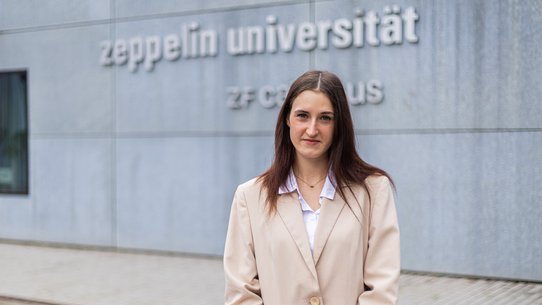
What does receiving the scholarship mean to you, and how does it enable you to do things that would not be possible otherwise?
Diana: I remember when I just applied for the scholarship, and I was waiting for an answer, I was checking my email every hour. I was just so surprised that someone believed in me that much. If not only you believe in yourself, but there is someone else, who doesn’t even know you and still believes in you so much they are ready to provide for your education in such a good university, it's just amazing. It gives you such a boost of confidence, in what you want to do with your life and what you want to achieve. I can't even express how thankful I am. I'm speechless because it's just something so special. I really admire my sponsor for doing that, and it's such an example for me of how people can support other people.
Do you stay in contact with your sponsor?
Diana: Yes, we’ve met once in person, and I send her letters. I really like that she wants to know me and is so invested in my life. And I know that I have to do it, not only for myself, but also to make her proud of me, and so she can see results. It's really nice to have this sort of personal connection.
How does this support affect your studies and the way you think about your future?
Diana: In Ukraine, we had a similar system where university graduates would sponsor other students, and I always thought it was such a wonderful idea—if a university has given you so much, why not give something back? When I heard about this scholarship, it immediately reminded me of what we have at home. It’s something I’d love to do by myself when I’m older. It just gives me huge motivation to do something, to achieve something, and not to give up. Especially when I first moved here without friends and struggled with the language, everything felt quite overwhelming. In those moments, knowing that someone believed in me—even when I didn’t myself—gave me so much power.
More articles
 10/08/2026LifeVillage Hub
Starting a business is a matter of practice
This year's Village Hub focuses on the question: If AI makes companies smaller, flatter, and faster—what skills do founders actually still need?- 09/28/2026LifePhoto Gallery
ZU Summer Festival, themed “Beyond borders.” featuring a diverse program and many guests
Zeppelin University opened its doors and invited anyone interested to meet, exchange ideas, and celebrate together.  08/17/2026LifeInvestor Summit Bodensee
Why Good Ideas Need the Right Connections
For founders seeking funding, the Investor Summit Bodensee is about much more than just a pitch on stage. After all, the most valuable connections are made afterward.- 08/03/2026LifeGlobal Talk with Andreas Kruse
How Young and Old Come Together
In a Global Talk, gerontologist Andreas Kruse explains how the generational conflict can be resolved and how society can be strengthened through interaction and collaboration.