No "Rambo-Zambo" in democracy - Why we need to retell the story of political action
Friedrich Merz's Freudian slip may initially appear to be a casual remark, but on closer inspection it reveals a deeper problem with Germany's political culture.
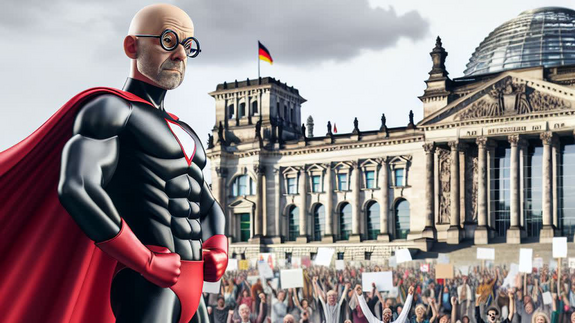
"Rambo-Zambo in the Konrad Adenauer House" - this is how Friedrich Merz announced the election victory of his party alliance of CDU and CSU in the German federal elections in 2025. The Freudian slip of the tongue may initially appear to be a casual remark, but on closer inspection it reveals a deeper problem with Germany's political culture. Politics is not seen as a collective and goal-oriented interplay between different interest groups, but rather as a power struggle between assertive individuals. Two narrative strategies support this problem: personalization and the narrative of politics as a hero's journey.
Merz's choice of words deliberately draws on the image of the lone fighter John Rambo, who stands his ground against a hostile system. A tough, uncompromising guy who doesn't argue, but acts according to his own opinion. This narrative style is not chosen by chance, but is an expression of a popular political strategy: politics is reduced to individuals, to their characters and "fighting spirit". Programs, processes and institutional structures are relegated to the background.
Heading
The hero's journey is one of the oldest narrative patterns known to mankind. It was first made famous by the American myth researcher Joseph Campbell, who developed a universal narrative pattern in his work The Hero with a Thousand Faces (1949). Campbell showed that many myths and stories are about a central figure who has to overcome a challenge, fights against enemies and finally returns triumphant or purified.
Hollywood picked up on this pattern - from Star Wars to Harry Potter, countless films are based on Campbell's so-called "monomyth". But while this makes for captivating stories in pop culture, it is problematic in politics. Democracy is not an epic myth, but a complex interplay of parties, institutions and voters.
The idea that a single "strong man" can solve political problems is not only under-complex, but dangerous. It overlooks the fact that democratic processes are deliberately designed for consensus, negotiation and long-term institutional stability - not for heroic solo efforts.
How personalization is changing political reporting
It is no coincidence that election campaigns and political reporting are becoming increasingly personalized. The development can be traced back to the 1960s, when the US media landscape changed and competition for attention increased. Television in particular contributed to politics being staged more as a battle of personalities.
While the focus used to be primarily on parties and programs, the emphasis shifted to charismatic leading candidates, whose appearance, rhetorical skills and personal stories increasingly became the decisive factor. This change was reinforced by the emergence of talk shows, live debates and, in recent years, social media.
Today, formats such as duels or trials have become almost unavoidable - they stage politics as a battle in which there are clear winners and losers. This gives the impression that the election is a decision between individuals, not between political concepts and programs.
Why personalization harms democracy
But heroes need opponents. In political reality, this means that populist rhetoric often creates abstract enemy images: "the unemployed", "the foreigners", "the aloof elite". The "hero" stands up to them, but such a battle can never be won. It only ensures a constant renewal of crises and conflicts, which in turn legitimize new heroic figures.
Even more problematic is that the idea of the hero's journey is transferred to the democratic process. It suggests that checks and balances, parliamentary procedures and political compromises are obstructive obstacles - something that the "hero" must circumvent or break through. Yet it is precisely these mechanisms that make democratic systems stable and resilient.
Learning from Rambo: A system without a process leads to destruction
John Rambo, the movie hero, is ultimately a tragic figure. As a Vietnam veteran, he was first celebrated by society, then abandoned. His former military strength becomes a social burden, his actions end in destruction. In the end, he breaks down in tears and despair, unable to find a place for himself and the only thing he is really good at - fighting.
A political system that follows this pattern runs the risk of repeating precisely this: instead of promoting stable processes, it creates short-term heroic narratives that quickly fade, with potentially fatal consequences for trust in democracy.
Think in terms of processes, not people
Democracy does not need heroes. It needs committed citizens, institutions that work reliably and a political culture that focuses on the process rather than the individual.
"Rambo-Zambo" is not the narrative that a modern democracy needs. What we need instead is a political culture that looks beyond individuals and relies on change being shaped together - and not by individual "strong men".
To the author:
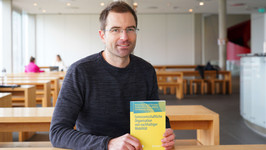
PD Dr. Martin R. Herbers heads the Center for Political Communication at Zeppelin University in Friedrichshafen. He is a member of the international and inter-university network Political Communication netPOL. He researches and teaches on the interplay between democracy, the public sphere and technology.
More articles
 03/12/2026ScienceGuest article by PD Dr. Martin R. Herbers
Kick-off without a blueprint: What the state election in Baden-Württemberg reveals about the super election year 2026
After the state elections in Baden-Württemberg, the search for the "great lesson" begins. Is it just a revealing prelude or even a blueprint? 12/16/2025ScienceMobility cooperatives
Better to share than (not) own
Innovation researcher Matthias Weiss talks in an interview about the potential, opportunities and challenges of mobility cooperatives. 11/25/2025ScienceDigital technologies in communication
Trust is about understanding
PD Dr. Martin R. Herbers explains how the digital transformation is challenging our democracy and how communication science can meet this challenge.- 04/29/2025ScienceTransport policy
What happens to the special infrastructure assets?
The next government has put together a 500 billion package. What will be left of this for the transport infrastructure? asks Alexander Eisenkopf.