Philipp Sommer: Controlled risk-taking
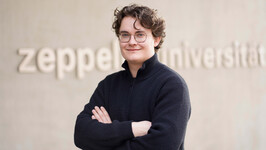
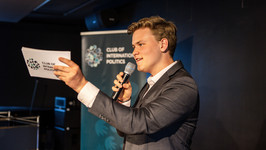
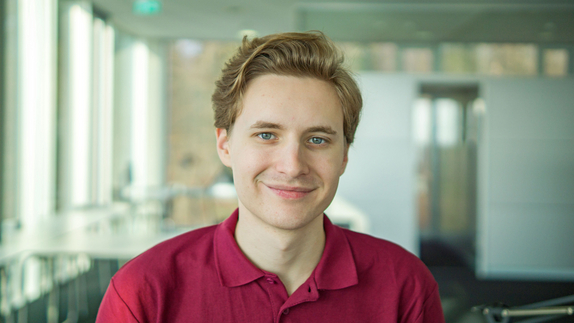
Philipp Sommer has taken as many courses as possible, not because he has to, but because he wants to. He tries to satisfy his curiosity and thirst for knowledge by taking full advantage of what the CME Bachelor offers him. So far, this has included a semester abroad at the Haas School of Business at UC Berkeley and internships in three different business sectors. And as if that wasn't enough, Philipp Sommer co-founded the start-up "Mein Helfair", which supports senior citizens with everyday tasks.
Philipp Sommer grew up in Friedrichshafen-Manzell, just a stone's throw away from the two ZU sites at Seemooser Horn and Fallenbrunnen. After elementary school in Friedrichshafen-Fischbach, he went to Graf-Zeppelin-Gymnasium. When it came to choosing an A-level course after tenth grade, Philipp Sommer was one of the few who opted for economics. "The trigger was my father's work as a salesman for forklift trucks, which always had something intangible about it. That sparked my curiosity. When he returned home from his business trips, I always wanted to know exactly what he had experienced," recalls Sommer. The economics lessons, in turn, moved between the past, present and future: he learned more about the past global financial crisis, the rise of protectionism and the emerging cryptocurrencies. "Each topic helped me to understand economics a little better," explains Sommer.
It must have been around this time that the three friends Philipp Sommer, Hannes Burget and Moritz König came up with the idea of founding a company. "Each of us supports our grandparents when the TV or cell phone doesn't work the way they want it to. But not everyone is lucky enough to have a grandchild in the neighborhood," reports Sommer. "And so the question arose: Why not help other older people with technology or gardening?" As with many start-ups, it all began with a few flyers being distributed. "We took the first customer orders over the phone and dealt with them ourselves. From a small problem with a web browser to lawn mowing and weeding to the construction of a large patio, it was all there," says Sommer.
As demand continued to rise, they had to think about how to build up the start-up so that they could still handle the orders. Since then, they have taken a two-pronged approach, adding mini-jobbers to the team on the one hand and a digital platform on the other, where appointments can be booked and coordinated automatically. In any case, the start-up has gained a lot of momentum and "Rentnerhilfe Bodensee" has now become "Mein Helfair". "We not only cover the entire Lake Constance region, but have also opened our first locations in Constance, Wangen, Neustadt in the Black Forest and Ulm," adds Sommer. And he adds: "Our long-term goal is to operate nationwide at some point."
In the meantime, the founding team has completely withdrawn from contract work in order to be able to focus fully on developing the company. Philipp Sommer takes care of product development, scaling, marketing and collaborations. "I like being creatively involved with the start-up and constantly working on how our product can be improved," says Sommer.
Opportunity seen: Business interest leads to CME bachelor's degree
Philipp Sommer came across ZU more or less by chance - which is surprising, given that it was only a stone's throw from his parents' house to the ZU campuses. "This was mainly due to the fact that studying at a university only landed on my agenda when I was about to graduate from high school," says Sommer. The decisive factor for the CME Bachelor's degree was the study profile: "However, it wasn't just the business administration and economics courses that excited me, but also the opportunity to further develop the start-up in the PioneerPort start-up center," explains Sommer. What initially proved to be a hurdle that had to be overcome, however, was studying itself. "As neither my father nor my mother had studied, they couldn't explain to me what studying was all about. I therefore had to work everything out for myself," explains Sommer.
But once he had arrived at university, Philipp Sommer made the most of the opportunities presented to him. And so, from the third semester onwards, he took the opportunity and accepted the challenge of venturing into numerical areas in particular: finance, accounting, controlling, business mathematics, applied statistics and econometrics. Apart from any theory, it was important to him to gain as many insights as possible into business practice - or as he puts it: "into companies and institutions that make capitalism into capitalism". He therefore completed three fundamentally different internships in the areas of mergers & acquisitions, private equity and financial transactions. "It's like the start-up: I always find it exciting to immerse myself in a foreign subject until I get to grips with it. Because the sense of achievement I gain in the process is exactly what drives my motivation curve upwards," explains Sommer. In addition to all kinds of financial topics, his semester abroad at the Haas School of Business at UC Berkeley took him into another unknown territory: coding. "And I already know that I will not only need my programming skills in my bachelor's thesis on capital market research, but also want to expand them," Sommer reveals.
To gain a new perspective on founding, Philipp Sommer also took a course at UC Berkeley with a professor who has already founded several companies in his life. A few semesters earlier, he and his co-founders had already moved into the PioneerPort on the SeeCampus as a racing team selected by a jury in order to benefit from advice, access to networks and funding programs, events and workshops. "It was important for us to compare our often intuitive actions with sound expertise and thus arrive at decisions that would help our start-up move forward," remarks Sommer. Which legal form is the right one? How does networking work? And how can successful marketing and funding be achieved? These and other important questions had to be clarified. "Without the support of PioneerPort, we wouldn't be where we are today as a start-up," emphasizes Sommer.
Risk diversified: full-time start-up or Master in Finance
The start-up has since won over other juries and prevailed against other start-up teams in various finals: "Mein Helfair" has been awarded the SENovation Award, the Paul Lechler Prize and the Gründerländ Prize, among others. "At least as important as the prize money are the coaches and mentors who are on hand to advise us on all aspects of starting up and give us valuable tips along the way," remarks Sommer.
Another start-up idea, which Philipp Sommer worked on with three fellow students in a recently completed entrepreneurship course, is also aiming high: "We can only reveal this much: We have developed an app that makes it easier to track exercises in the gym. The prototype has already been developed and will soon be followed by a market analysis and answers to the questions of whether it is technically feasible and the product is profitable."
Philipp Sommer still sees his work for "Mein Helfair" as a hobby alongside his studies. "But at the end of the year, we want to decide together how to proceed," says Sommer. A lot also depends on whether the start-up receives funding from the EXIST start-up grant. "Inclusion in the funding program would mean a funding commitment that would enable us to drive the start-up forward full-time," says Sommer, who has another ace up his sleeve with a master's degree specializing in finance: "Because I don't want to bet on one horse yet, but rather spread the risk widely."
More articles
 09/25/2025PeoplePioneer of the month
Augustin Renz: Juggler with three standing legs
Augustin Renz likes the roles of the lobbyist in university politics, the bachelor student between sociology, politics and economics and the qualitative and quantitative researcher.- 05/21/2026PeoplePioneer of the month
Max Baier: Between bakery and library
Max Baier is studying for a CME Bachelor's degree at ZU. And has learned something new: Just like in the bakery trade, you also have to penetrate the subject matter in business studies in order to understand it. - 11/13/2025PeoplePioneer of the month
Gabriel Hoensbroech: Enduring more opinion
"Stand up for what you believe is right": Gabriel Hoensbroech takes this to heart in everything he does and says.  10/16/2025PeoplePioneer of the month
Jil Tischer: Do it yourself - but together
The dynamic and energetic environment at ZU encouraged Jil Tischer to think big and realize even bigger projects.