Gregor Gysi and the art of explaining politics with humor
Why talk shows annoy him, why the culture of the Bundestag is changing noticeably and why he and Friedrich Merz are on first-name terms: Gregor Gysi, long-time leader of the Left Party, shows how light-footed political analysis can be in the CIP talk at Zeppelin University.
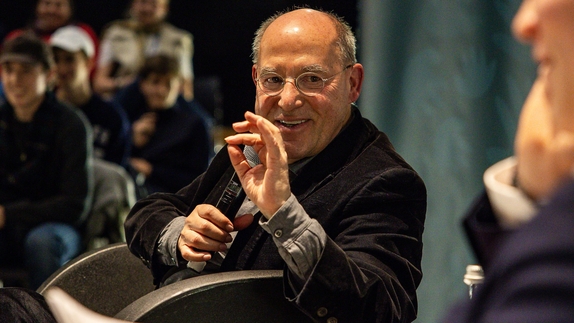
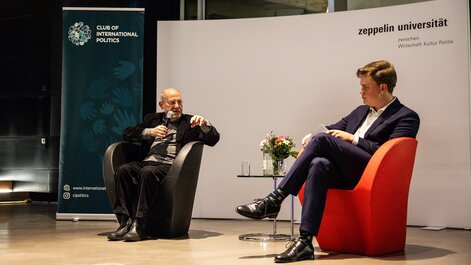
When Gregor Gysi enters the Graf von Soden Forum this evening, a mischievous smile flits across the faces of many in the room. The well-known mixture of self-deprecating remarks, cheeky debates and clear analysis has characterized his appearance for years. Instead of sitting in the studio of Maischberger or Lanz, today he is in the middle of the ZU campus: invited by the Club of International Politics.
Gysi, who grew up in East Berlin, was once a lawyer and later a formative figure in the East German opposition, is now a directly elected member of the Bundestag from Berlin Treptow-Köpenick for Die Linke. What still sets him apart today is his politically trained mind, which never hides his origins in the GDR: packaged in humor.
"What annoys me about TV talk shows anyway is that there are other people sitting there," says Gysi dryly, making it clear how much he appreciates the ZU atmosphere at that moment. "And they're always in the evening, I'd much rather go for a beer." When moderator Gabriel Hoensbroech, Chairman of the CIP and politics student, asks him with a grin whether he would prefer to do the same that evening, Gysi counters: "I like it here. I'm alone here and nobody interrupts me." 350 people in the audience laugh.
When the political mood changes: Gysi on the new climate in the Bundestag
While the Graf-von-Soden-Forum is an expectant mixture of political analysis and Berlin cabaret, things are different in parliament. The mood in the Bundestag, says Gysi, has changed noticeably - and not for the better. In the Bundestag, the joy over the presence of a certain party is limited.
This refers to the AfD. Its arrival has fundamentally changed the climate, the tone and the entire feeling in the chamber, explains Gysi: "My party used to be the object of hatred." Now it is the Alternative for Germany.
Gregor Gysi speaks openly about a coalition that is struggling with itself on many issues and about a CDU that cannot decide whether it wants to moderate or polarize. Federal Chancellor Friedrich Merz in particular receives a few side blows that evening. "Merz is running after events without having a political goal," commented Gysi. By this he means that politics without a recognizable line loses orientation and trust.
Presenter Gabriel Hoensbroech broadens the view and critically asks how the politician assesses the limits of Germany's ability to act, which is under both internal and external pressure. Gysi explains that there is a lot of external pressure from the USA, because Trump wants "us to dismantle democracy and the rule of law". In turn, the AfD is exerting pressure from within, shifting basic political attitudes. "But we only realize how much democracy, freedom and the rule of law are worth when they are gone," says Gysi. This makes it clear how important it is to him that we recognize the importance of these values and understand how worthy they are of protection.
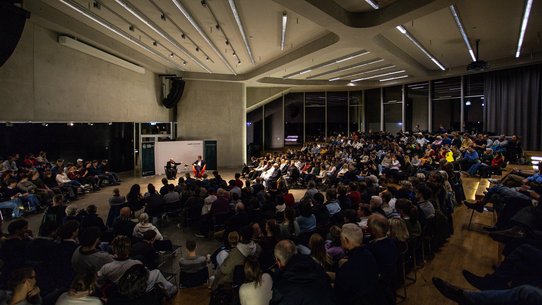
Gysi and Merz are already on first-name terms: the only thing missing is the glass of wine
Gysi and Merz may already be on first-name terms, but it's not entirely voluntary. Both were awarded the "Against Animal Seriousness" medal by the Aachen Carnival Association - Merz in 2006 and Gysi in 2017. And with this award comes an unusual rule: the recipients of the order are on first-name terms with each other.
When asked how he would deal with Merz in the role of advisor, Gysi replies that he would first "invite him for a glass of wine". He would like to make it clear to him that Friedrich Merz (CDU) and Lars Klingbeil (SPD), Vice-Chancellor and Federal Minister of Finance, must finally learn to deal constructively with each other in the cabinet. "Klingbeil must accept that Merz is Chancellor, and Merz must accept that he has a coalition partner and cannot make decisions alone," explains the MP. He believes that political cooperation fails when central players deny each other legitimacy and that this is exactly what blocks any joint decision.
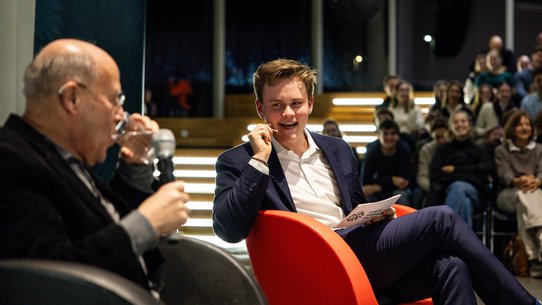
"Ukraine's victory is an illusion."
When ZU student Hoensbroech brings up the topic of Ukraine - an issue that regularly causes debate in Die Linke - the room becomes noticeably quieter. For Gysi, it is clear that Ukraine cannot win the war. However, if the EU had called for a ceasefire at an early stage, it would be more involved in diplomatic processes today, he says. Instead, it is now caught between external expectations and its own political turmoil.
Moderator Hoensbroech clearly disagrees. An enforced ceasefire under Russian conditions, he argues, would not only legitimize violence, but would also send a fatal signal to other authoritarian states. Deterrence is a prerequisite for diplomacy to be effective at all.
Gysi counters and recounts how he advised Friedrich Merz and Marie-Agnes Strack-Zimmermann, FDP politician and Member of the European Parliament, that NATO and EU states should call for a ceasefire between Russia and Ukraine as soon as possible. The reaction at the time was that this would not happen anyway. Today, according to Gysi, this is precisely the problem. "If Trump demands it, then at least Putin would know that we demanded it too," he comments, making it clear that Germany might now be at the negotiating table.
This reveals two clearly opposing world views. Hoensbroech is adamant that without Germany's clear security policy responsibility within NATO, Europe would lose its own strategic ability to act.
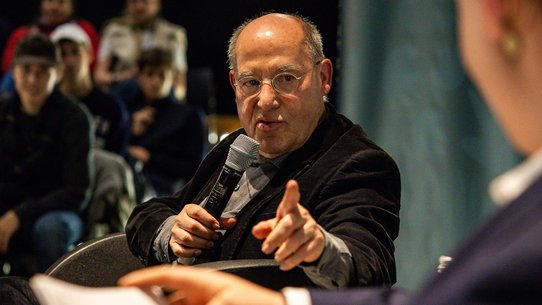
The shift to the right did not come out of nowhere, explains Gysi. It arises where parties try to catch up with the AfD rhetorically. "If you try it with the AfD, then people vote for the original, not the copy," he says.
CDU member Hoensbroech is a match for the politician when it comes to the core content. The ZU student presents himself objectively and without shying away from contradiction by asking whether Gysi has a proposal to counter the shift to the right.
The member of the Bundestag then proposes a meeting of all democratic forces - supplemented by voices from science, art and culture - to think strategically about how to counter the pressure. Cooperation is needed, he appeals.
Israel, Palestine and the Left: Gysi on the Middle East conflict
Due to the increased accusations of anti-Semitism against his party, CIP Chairman Hoensbroech deliberately addresses the topic of the Middle East critically and asks the politician whether Die Linke is clear about its line within the party. Gysi admits that his party must learn to act more consistently when internal boundaries are crossed, especially with regard to the youth association. Criticism of Israel and the Netanyahu government is legitimate, he emphasizes, but not as a cover for anti-Semitic narratives.
The Left is fundamentally in favor of a secure Israel, but also a secure Palestine. The resolution of a two-state solution must finally be pursued seriously. However, anyone calling for solidarity must not forget the attack on Israel by the terrorist organization Hamas on 7 October 2023. "Many people do," says Gysi, making it clear how quickly debates become one-sided.
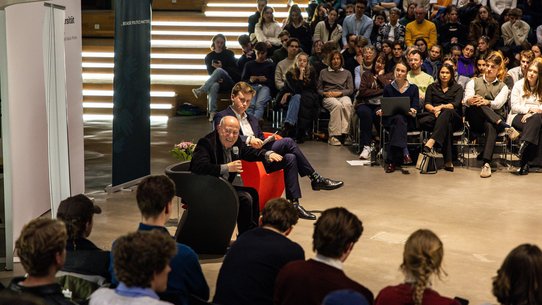
On this evening, the Club of International Politics also welcomes guests from the Humboldt Institute, an association for German as a foreign language, to the audience. Hoensbroech gives a student the floor. The young man reports that he came to Germany from Somalia a year ago and asks Gregor Gysi what opportunities his party can offer him for his integration. The politician places the topic of migration in a larger context and names three prerequisites: He must be allowed to learn German as early as possible, he must be able to work as early as possible and families must not be clustered in a few streets. "That's how clan structures develop," he explains.
For him, it is clear that the state has a duty to provide opportunities. Education, language courses, fair access. Only when these foundations have been laid can we talk about what responsibility lies with the people themselves.
Thank you, Mr. Gysi.
At the end of the evening, it becomes clear what Gregor Gysi sees as the core task of an opposition: To provide arguments that change the zeitgeist. Whether he succeeds in anchoring this claim in his party and beyond will become clear at the next election at the latest. We are curious.
An evening like this shows how lively the exchange of different perspectives can be at Zeppelin University. ZU is grateful that Gregor Gysi took on the long journey from Berlin for us and, together with Gabriel Hoensbroech, made this open dialog possible.
More articles
 10/08/2026LifeVillage Hub
Starting a business is a matter of practice
This year's Village Hub focuses on the question: If AI makes companies smaller, flatter, and faster—what skills do founders actually still need?- 09/28/2026LifePhoto Gallery
ZU Summer Festival, themed “Beyond borders.” featuring a diverse program and many guests
Zeppelin University opened its doors and invited anyone interested to meet, exchange ideas, and celebrate together.  08/17/2026LifeInvestor Summit Bodensee
Why Good Ideas Need the Right Connections
For founders seeking funding, the Investor Summit Bodensee is about much more than just a pitch on stage. After all, the most valuable connections are made afterward.- 08/03/2026LifeGlobal Talk with Andreas Kruse
How Young and Old Come Together
In a Global Talk, gerontologist Andreas Kruse explains how the generational conflict can be resolved and how society can be strengthened through interaction and collaboration.