Allies in the fight against climate change
Tourists love nothing more than long white sandy beaches, which are usually advertised as "wild and untouched". The opposite is usually the case: they are the result of an ecological outrage - the deforestation of the mangroves. Whether the tidal forests will survive further destruction by humans is more than questionable. In the Seychelles, several initiatives are now taking action against this. ZU guest researcher Angelica V. Marte and social and cultural anthropologist Werner Zips found out how they are doing this.
Mangroves, which can grow up to 60 meters out of the sea, still cover 15 percent of the world's coasts. In the natural habitats of mangrove forests, where the sea meets shallow coastal areas, they provide a variety of ecosystem services as CO2 reservoirs, water filters, coastal protection, habitats for young animals and sources of income for local populations. Nevertheless, they are under severe pressure in many places.
Environmental pollution - especially the plastic pollution of rivers ending in the sea with its devastating effects on coastal vegetation - and the still barely slowed deforestation by humans are causing them problems. Over the past 50 years, their main enemy - mankind - has caused the destruction of over a third of all mangroves. Based on data from the Global Mangrove Watch (GMW), the WWF estimates a total loss of 40 percent. In most cases, they have had to make way for human constructions such as hotels. In many places, aquacultures for farmed fish have replaced the natural spawning grounds of all wild reef fish species.
This exchange of wild fish for farms in the sea leads to high consequential costs for ecological integrity, but also for human health. Farmed fish are often infested with parasites and pumped full of antibiotics. In terms of human food security, the apparent promotion of the economy is proving to be just as short-sighted as the renunciation of coastal protection against rising seas and the associated coastal erosion. Not to mention the increasing danger of extreme weather events or tsunamis.
Mangroves would be mankind's best allies in the fight against the consequences of global warming. According to various estimates, they store five to ten times more carbon than forests on land. Marine biologists therefore like to call them the "rainforests of the sea". In the diverse ecosystems of mangrove forests, countless aquatic life forms, as well as many bird species and reptiles, find protected habitats for their young. After decades of thoughtless destruction worldwide, a rethink has begun. This is increasingly evident in government, private and community initiatives to reforest tidal forests. In the Seychelles, large hotels and resorts are also becoming increasingly involved. We would therefore like to report on their initiatives on a pars pro toto basis.
The atolls of the Outer Islands in the Seychelles
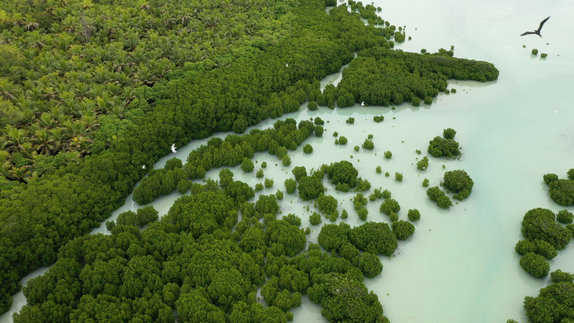
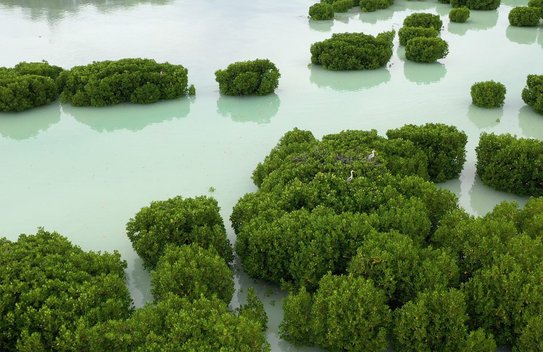
It doesn't get much more remote than this in the Seychelles. After a boat trip of just under 30 minutes, the skipper stops around 30 meters off Saint-François, an atoll in the outer Seychelles that belongs to the Alphonse group. Now it's time to swim and wade. If you want to get to this coral island, you first have to go through the "Canal de Mort". Nomen est omen, the "Canal of Death" is also famous for its shipwrecks. Marine biologist Eleanor Brighton knows the biodiversity with its breeding colonies of various species of seabirds in the lagoon's mangrove forest. Now she looks dismayed: "I've never seen it like this in all my years. Normally, only parts of the forest are under water. It must be due to the heavy rainfall of the past few days. I'm afraid we can only get to the black-naped terns by swimming now."
Eleanor recognizes the sceptical looks: "The lagoon can't be more than one and a half metres deep, we can wade through it." We've barely finished speaking when we're startled by a loud splash, as if Moby Dick had belly-flopped. Now she is much less successful in encouraging us: "Something big is on the hunt here." To the stressed question "Like what?" comes the laconic answer "Could be a bull shark or a grouper, they like to hunt in shallow water. Don't worry! We're not on their menu."
In the nursery of blacktip and lemon sharks
It will still take some time for us to relax in Eleanor's lee and wade through the murky seawater of the lagoon. But then the whole wonderland of these tidal forests unfolds. Fairy terns hunt over our heads and frigate birds return from their extensive fishing trips. We spot seven stingrays in the knee-deep water near the sandbank, obviously on the prowl. Eleanor is thrilled: "The scientific name for this species of ray is Urogymnus granulatus, also known as the mangrove whiptail ray. I wouldn't get too close. They are highly poisonous. Deadly, to be precise." Suddenly, two apparently curious lesser blacktip sharks - the name of the species - appear.
"Don't worry," Eleanor reassures them, "they're still baby sharks. We're just marching through their nursery. They're probably brothers and sisters. Maybe they were splashing around earlier." They like to jump out of the water when they are chasing a school of fish. The females give birth to between one and ten young. The special thing about this species is that it can reproduce asexually. This juvenile reproduction is their only salvation. According to the International Union for Conservation of Nature (IUCN), they are endangered - mainly due to overfishing and low reproduction. Without the nurseries in the mangrove forests, which are hardly accessible to human fishing, they would probably already be extinct. Just like a so-called "shark school" of young sickle-fin lemon sharks that curiously circle us. "They just want to play," Eleanor knows.
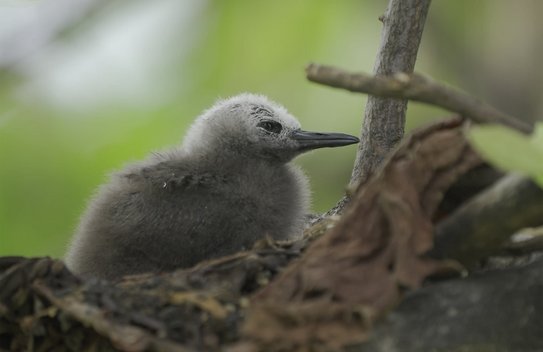
Mangrove ecology as a vacation university
Before dinner, Eleanor gives a lecture on mangrove ecology to the guests of the only resort far and wide on the neighboring island of Alphonse. The marine biologist from the heart of London works as an ecology and sustainability manager for Blue Safari, a South African tourism company that specializes in the most remote corners of the world. Her PowerPoint presentation, backed up with the latest scientific data and figures, is enlightening in the best sense of the word:
"For a long time, mankind regarded mangroves as an annoying natural obstruction of paradisiacal tropical beaches and cut them down without compromise. Yet they are our most important life insurance against the elemental force of the sea. It doesn't have to be tsunamis. The slow but steady erosion of the coast is enough. In short: mangrove forests protect against rising sea levels, wind, waves and the voracious power of the tides. They are also highly effective carbon sinks and are therefore natural allies of humans in the fight against climate change. That's why our bungalows on Alphonse are hidden behind mangroves without direct access to the beach."
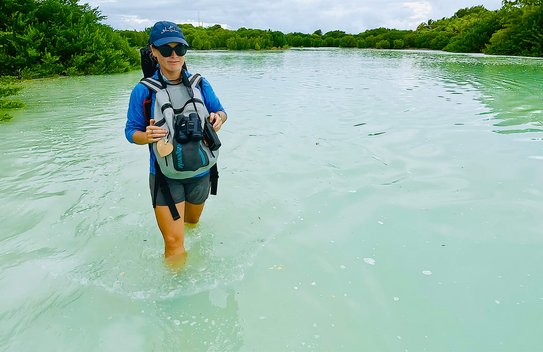
Luxury resorts and ecological (ge)knowledge
Mangroves and tourism - not a love story so far. Tempore mutantur. Since environmentally conscious travelers have been paying more and more attention to the carbon footprint and sustainability of the resorts, the relationship has improved sustainably. For a long time, tourism development in the Seychelles was a one-way street in the wrong direction - from the point of view of the mangrove forests. The construction of new hotels usually meant the removal of the mangroves - in favor of direct beach views from the suite and "pristine beaches" or what was considered to be such. Recent large-scale projects such as the Constance Ephelia in the north of the main island of Mahé show that things can be done differently.
The luxury resort is located in the middle of the first wetland reserve under the Ramsar Convention, as German-born biologist Markus Ultsch-Unrath explains on his daily "walking safaris" through the extensive mangrove forests:
"There are seven species of mangroves in the Seychelles, all of which can be found in our protected area. It is the last large mangrove wetland on the main islands. To protect these 120 hectares, we have established a cooperation between the hotel, the government and the surrounding communities. We want to make everyone aware of the need to preserve the mangroves. This means increasing responsibility for the natural purity of this important filter between the rivers and the sea. Plastic is also omnipresent in the Seychelles. That is why we organize a mangrove clean-up day every six months. This also raises awareness for the sustainable use of plastic and other pollutants. We have also set up a tree nursery for mangroves, which we regularly reintroduce to the wild together with the communities. Interested guests of the resort also take part in this, which promotes relationships between locals and tourists."
The resort's sustainability coordinator Hilary Albert, who herself comes from the main island of Mahé, is primarily responsible for this. Her favorite project is the production of mangrove honey: "Our bees collect the pollen from the mangrove flowers, which they turn into honey in our beehives. At the end of a mangrove tour for tourists, I always present our bee project, which also benefits the local population. All the more reason for them to support the rehabilitation of the mangroves."
Sustainability certifications as a sales argument
It is no wonder that the Constance Ephelia was the first hotel in the Seychelles to receive sustainability certification from Green Globe, an initiative to achieve the UN Sustainable Development Goals for tourism. However, Markus Ultsch-Unrath, the hotel's sustainability manager, finds the practical aspects even more important. His reforestation program is accepted by many guests and thus indirectly increases the global acceptance of renaturation projects in the very best interest of mankind. Adventure vacations in the form of active environmental protection are becoming a marketing hit. Nature is once again taking center stage.
With the help of local volunteers, Markus and Hilary drag up to 40 saplings, roots and soil from the hotel's own tree nursery to the ridge on the edge of the resort. At a suitable spot, they help the enthusiastic tourists plant their own tree in the Seychelles. "So far, we have planted countless rare trees and over 4,000 mangroves. Surrounded by the mountains of the Morne Seychelles National Park on land and the Baie Ternay Marine National Park on water, we feel a special responsibility for nature conservation."
For Ameer Ebrahim, the mastermind behind the government's national fisheries management plan and advisor to countless environmental projects, this is the order of the day. The marine biologist was partly responsible for the Seychelles committing to protecting 50 percent of its remaining mangroves and marine meadow habitats by this year 2025 and 100 percent by 2030: "Mangroves and marine meadows are the backbone of our food security and guarantors of our continued existence. They are the nursery of all our reef fish that feed us and also protect our coral islands from extinction."
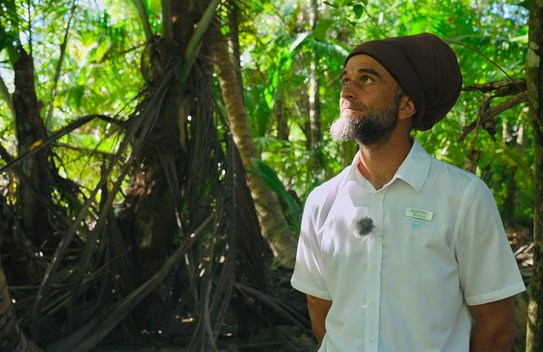
Tempo-centrism as a discontinued model
In the past, there was often a lack of foresight - even in the Seychelles. The focus was on short-term (and short-sighted) material considerations. More and more investors, entrepreneurs and, above all, local politicians are turning away from this speed-centrism, which stands for the neglect of long-term consequences in favor of quick profitability calculations. In recent years, there has been a visible increase in environmental awareness, with long-term legacy taking precedence over short-term profits. Sunil Shah, hotel owner of the JA Enchanted Island Resort on Round Island in the middle of the Sainte Anne Marine National Park, planted 20,000 plants on the tiny island. This turned the ecologically degraded former leper island into a tropical paradise for rare native species:
"This island is hundreds of millions of years old. I have just appeared on the scene. In geological terms, our individual existence is not even a fraction of a millisecond. But what we do during our limited life on this planet has an enormous impact on the state of the planet. We must therefore always be aware of our true legacy."
Now that tourists are increasingly asking about the carbon footprint and carbon footprint of their hotel of choice, the relationship between humans and mangroves is improving noticeably. Renaturation is at the top of many social media channels and in tourism marketing. As travelers, we can all make a contribution to this by consciously asking the ecological question before we book and making our decisions accordingly.
More articles
 10/24/2024ScienceVenice Biennale
A journey through contemporary African art
Does a visit to the Venice Biennale pay off? The answer from ZU guest scientist Angelica V. Marte and Werner Zips needs a call sign: And how! 12/10/2024ScienceSustainable corporate culture
Gamechanger men: why equality only works with them
The study "Gender Equality - the role of male managers in transformative corporate culture change" by Linda Suhm calls for a rethink of gender equality. 09/21/2026ScienceThree Questions for Simon Koschut
Security. Europe. Responsibility.
How Europe's security order is changing, what role transatlantic relations play in this process, and what responsibilities academia and universities bear in a new security landscape. 07/16/2026ScienceThree Questions for Anja Achtziger
More Than Just Studying. Motivating. Making Decisions. Taking Responsibility.
Why Zeppelin University emphasizes judgment, responsibility, and interdisciplinary thinking, and why these skills are more important than ever before.