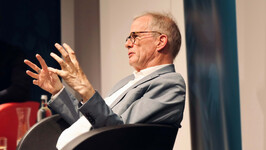
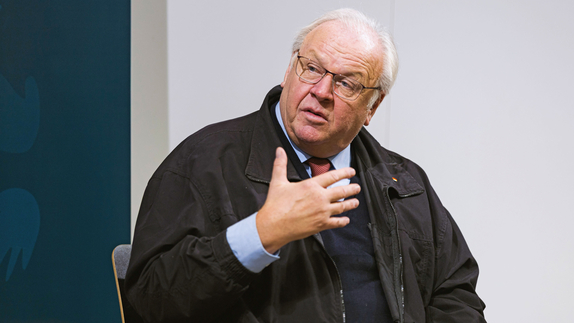
Former ambassador Martin Erdmann on Europe's security in transition
The Global Talk of the Club of International Politics e.V. was an evening full of insights into international security policy. Former ambassador Martin Erdmann shed light on the challenges facing NATO, transatlantic relations between the USA, Germany and Europe and the geopolitical role of Turkey. He not only drew a picture of the current challenges, but also provided food for thought for the future.
Martin Erdmann took the audience on a journey through the eventful history of transatlantic relations. He recalled key turning points, including the "almost fateful Wednesday" on which Donald Trump won the US presidential election - an event that he believes will profoundly change Europe's security architecture. The question of how Germany and Europe should react to the increasing unpredictability of the USA was a recurring theme throughout the evening.
Erdmann emphasized the importance of European unity in the face of the challenges: "Europeans must finally unite," he warned. The urgency of a coherent European security strategy became clear when he criticized Europe's dependence on the American nuclear shield. In his view, Europe would hardly be able to guarantee its own security without this protection.
But instead of getting lost in figures and statistics, Erdmann focused on the fundamental strategic questions: How can Europe become more independent? And what role should Germany play in this?
A question of responsibility
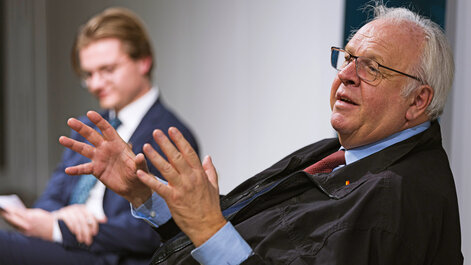
A central topic of the evening was the often controversially discussed burden-sharing within NATO. Erdmann placed the two percent target of the member states at the center of his presentation and critically questioned the current calculation methods. According to his assessment, the figures do not always reflect the actual willingness of a nation to invest in its defense capabilities.
Erdmann also made it clear that it was not just about figures, but about a fundamental attitude: Europe must be prepared to take more responsibility for its own security. "We must invest in conventional missiles and a modernized air force. Our external security must no longer be neglected," he appealed. The appeal struck a chord with the audience and led to lively discussions in the subsequent Q&A session.
Turkey - bridge or breaking point?
Another focus of the evening was Turkey's role within NATO and its geopolitical positioning. Erdmann outlined Turkey as a country full of contradictions: on the one hand, it has enormous potential - from its stable demographics to the dynamism of its economy, which offers the best conditions for renewable energies. On the other hand, autocratic developments under President Erdogan are causing increasing tensions between Turkey and the West.
With regard to the geopolitical situation, Erdmann emphasized Turkey's strategic importance: "The country is located at one of the most crucial interfaces in world politics - between Europe, Africa and Russia." He emphasized that Turkey holds both opportunities and risks for NATO and European security policy. The closer relations between Erdogan and Putin and the growing influence of China would pose considerable challenges for NATO.
Despite all the tensions, Erdmann was optimistic that Turkey could return to a policy that is more in line with the West's ideas in the long term. However, maintaining this balance is one of the major tasks of the international community.
Challenges for Germany
At the end of the evening, Erdmann took a look at the upcoming challenges for Germany and Europe. He made it clear that the world has become more insecure and that Germany must be prepared to take responsibility for its own security.
"German society is not ready for nuclear weapons, but without deterrence it will be difficult to guarantee our security," said Erdmann. This idea, coupled with an appeal to Europe's own responsibility, ran through the entire discussion. The former ambassador called on the audience not only to analyze the past, but also to play an active role in shaping the future.
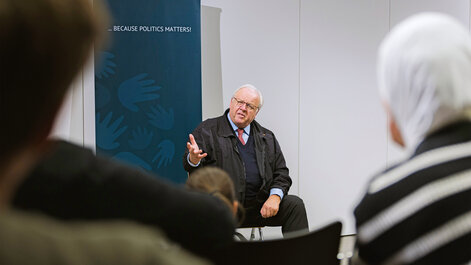
From transatlantic relations to the strategic role of Europe and Turkey - the evening not only revealed the most pressing challenges in global politics, but also delivered clear messages: without European ownership and an open dialog, the future of security remains uncertain.
More articles
 08/03/2026LifeGlobal Talk with Andreas Kruse
How Young and Old Come Together
In a Global Talk, gerontologist Andreas Kruse explains how the generational conflict can be resolved and how society can be strengthened through interaction and collaboration.- 10/08/2026LifeVillage Hub
Starting a business is a matter of practice
This year's Village Hub focuses on the question: If AI makes companies smaller, flatter, and faster—what skills do founders actually still need? - 09/28/2026LifePhoto Gallery
ZU Summer Festival, themed “Beyond borders.” featuring a diverse program and many guests
Zeppelin University opened its doors and invited anyone interested to meet, exchange ideas, and celebrate together.  08/17/2026LifeInvestor Summit Bodensee
Why Good Ideas Need the Right Connections
For founders seeking funding, the Investor Summit Bodensee is about much more than just a pitch on stage. After all, the most valuable connections are made afterward.