
Technology alone is not enough - the future of mobility needs connectivity
How do we change the way we get around? Technology alone will not be enough. A panel discussion at ZU showed why the key lies in interdisciplinarity.
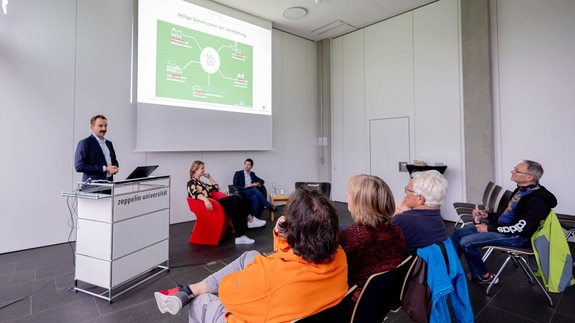
How can the mobility transition succeed? This question is the focus of a panel discussion at ZU. Dr. Christian Förster, Head of the Climate Protection in Transport Department at the Baden-Württemberg Ministry of Transport, told the audience that "the transport transition is more than just climate protection".
At the beginning of the discussion, he presented the ClimateMobilityMonitor. This is a quarterly reporting system from the Baden-Württemberg Ministry of Transport and provides information on how far the state has come in implementing the transport transition. While positive developments such as the increase in cycling and walking as well as successful parking space management are visible, the need for an accelerated turnaround in mobility remains obvious.
The state is also calling for a higher CO2 price and a more climate-friendly vehicle tax in order to achieve the goals of the transport transition more quickly and effectively. He also describes the so-called "corona effect", which has led to greater use of bicycles since the pandemic. This effect could contribute to a more sustainable mobility culture in the long term.
If the mobility turnaround fails, it won't be because of technology
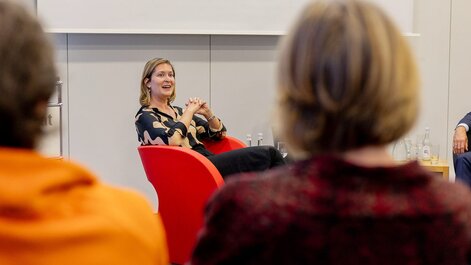
Dr. Isabella Geis, Head of Mobility, Infrastructure & Transport at Wavestone Germany and alumna of Zeppelin University, illustrates the importance of interdisciplinarity in digitalization and mobility. She was recommended by her professor for an internship at BMW, which sparked her enthusiasm for the mobility sector and strongly influenced her career path.
She explains that her employer Wavestone helps companies worldwide to adapt to a rapidly changing market and become more resilient, especially in times of digitalization and artificial intelligence. She emphasizes that the mobility transition cannot be achieved through technological advances alone, but that financial resources, political decisions and social acceptance also play a central role.
"We are at a point where the goals are technically achievable," she says, but emphasizes that without sufficient financial resources and political support, digitalization could fail. This shows once again how important it is to network different disciplines - from technology to finance and politics.
Geis also emphasizes that interdisciplinary work is not only desirable, but indispensable in the mobility industry. She quotes her supervisor, who tells the audience that "all seven senses" are required to be successful in this dynamic field. It is the ability to combine knowledge from different areas - technology, the environment, politics and business - that ultimately paves the way for a successful mobility turnaround.
Interdisciplinarity is thus presented not only as a supplement, but as a basic prerequisite for mastering the complex challenges of this industry.
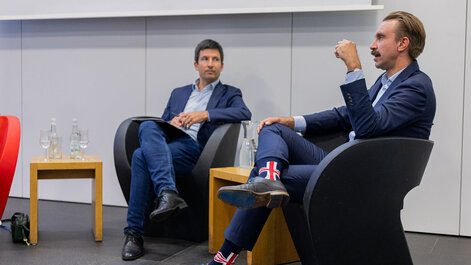
Throughout the event, it became clear that the mobility transition can only be driven forward through cooperation between different disciplines. It is not enough to look at individual aspects in isolation; rather, change requires comprehensive, networked thinking and action. The combination of technological progress, political support, financial resources and social acceptance are crucial to mastering the complex challenges and successfully shaping the mobility of the future.
The event is part of the European Mobility Week and the panel discussion will be moderated by Dr. Fabian Sennekamp, Consultant to the President and Managing Director, and responsible for sustainability management at Zeppelin University in Friedrichshafen.
More articles
 10/08/2026LifeVillage Hub
Starting a business is a matter of practice
This year's Village Hub focuses on the question: If AI makes companies smaller, flatter, and faster—what skills do founders actually still need?- 09/28/2026LifePhoto Gallery
ZU Summer Festival, themed “Beyond borders.” featuring a diverse program and many guests
Zeppelin University opened its doors and invited anyone interested to meet, exchange ideas, and celebrate together.  08/17/2026LifeInvestor Summit Bodensee
Why Good Ideas Need the Right Connections
For founders seeking funding, the Investor Summit Bodensee is about much more than just a pitch on stage. After all, the most valuable connections are made afterward.- 08/03/2026LifeGlobal Talk with Andreas Kruse
How Young and Old Come Together
In a Global Talk, gerontologist Andreas Kruse explains how the generational conflict can be resolved and how society can be strengthened through interaction and collaboration.