A journey through contemporary African art
Anyone who has not yet been to the Venice Biennale may be wondering whether it is worth visiting. The answer from ZU guest researcher Angelica V. Marte and social and cultural anthropologist Werner Zips needs a call sign: And how! There are still a good four weeks left for a short vacation, but it shouldn't be too short. After all, both had a whole week and afterwards the feeling that they had only just scratched the surface of their artistic and interpersonal dimensions.
This year's Biennale is an art exhibition of encounters with the foreign and the still unknown within oneself. It questions the level of historical and contemporary relationships of foreignness, which does not stop at the global dimensions of colonialism and migration, nor at one's own person. Her theme Stranieri Ovunque (Strangers Everywhere) is a claim, a concept and food for thought at the same time. It requires a trip to Venice - the unofficial world capital of tourism since time immemorial. In a broader sense, however, it requires a much further journey into those worlds of experience that have so far remained largely hidden behind the veil of exoticism and exoticism.
The first banal dimension assaults the arrivals at Santa Lucia Central Station as they push their suitcases body to body. It continues in the overcrowded vaporetto with densely packed, sweating bodies "from all over the world", to use an outdated term that alludes to the rulers or those in power who can afford such a (voluntary) journey. This gives an idea of the everyday experiences of the lagoon city, which has around 50,000 inhabitants and up to 165,000 visitors a day in the high season. Strangers everywhere - that fits Venice like a glove.
The Brazilian curator of the Biennale, Adriano Pedrosa, has deliberately made this connection. The artistic director of the São Paulo Art Museum was also inspired in his choice of theme by the anarchist collective Stranieri Ovunque from Turin, which took a stand against racism and xenophobia in the early 2000s. In his words, this (self-)critical dimension refers to the different freedom of movement and living conditions across states, nations, territories and borders:
"Reflected in (the related) crises are the dangers and pitfalls associated with language, translation and nationality. They underline the differences and inequalities caused by identity, nationality, race, gender, sexuality, freedom and prosperity. In this panorama, the title 'Strangers Everywhere' has several meanings. Firstly, that no matter where you go and where you are, you will always encounter strangers - they/we are everywhere. Secondly, that no matter where you are, you are always, actually and deep down, a stranger."
For Pedrosa, however, the expression "strangers everywhere" can also mean a motto, a slogan, a call to action and an outcry of enthusiasm, joy or fear. Furthermore, the title also refers to today's (politics of) fear in Europe and elsewhere of growing refugee movements. This art journey is perhaps particularly recommended for anyone who finds some of these references particularly provocative. The exhibition is (largely) free of the invective and moralistic high notes that sometimes overwhelm the human ear in today's debates. The focus is on identities and their historically charged relationships, but without the short-circuiting of identity politics, which equates what is (in each case) one's own with what is good and infallibly right. Here are a few highlights that are by no means intended to limit our own exploration of the 331 participating artists and numerous events surrounding the Biennale.
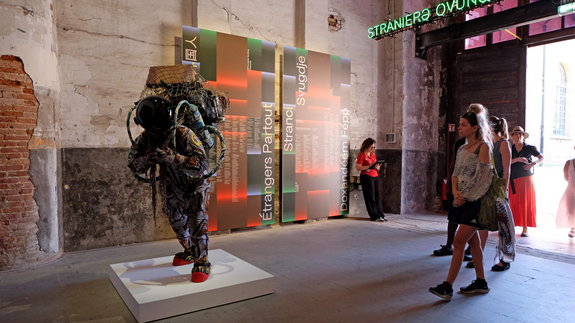
Let's start chronologically in the entrance hall to the Arsenale, which is explicitly dedicated to the theme. Framed by the multicolored and multilingual neon lettering on Stranieri Ovunque by Claire Fontaine, we encounter the life-size sculpture "Refugee Astronaut VIII" by Yinka Shonibare. With its African garb, it evokes associations with boat people fleeing Africa, which a bulging rucksack of earthly possessions and a kind of diving helmet with an oxygen tank condenses into an allegory of impending environmental catastrophes and humanitarian crises.
As is so often the case with this pointedly interactive Biennale, it is worth lingering at the artwork, not only to read the accompanying text on its ambiguous content, but above all to let the different reactions of the visitors to this entrée take effect. True to the quote "Is this art or can it go?", quite a few people stroll carelessly past Shonibare's refugee astronauts as if the sculpture were a kind of signpost. The work exemplifies the central themes of migration and decolonization. Just like the selection of artists, who - according to Adriano Pedrosa (in the exhibition catalog) - are predominantly foreigners, immigrants, expats, diasporic, émigrés, exiles or refugees themselves.
In accordance with our self-chosen focus, we are concentrating on artists from Africa and the African diaspora. This is possible to an unprecedented extent at this Biennale. No fewer than 18 of a total of 87 national pavilions are presenting art with an African perspective. In addition to the African national exhibitions from Egypt, Ethiopia, Benin, the Democratic Republic of the Congo, Cameroon, Nigeria, the Republic of Côte d'Ivoire, Senegal, Seychelles, Zimbabwe, South Africa, Tanzania and Uganda, these include France, Great Britain, Canada, the Netherlands and Portugal. In conjunction with the omnipresent indigenous focus and other aspects of diversity, the Biennale sees itself as an enthusiastic call for cultural diversity and the cross-fertilization of mutual foreignness.
"Contemporary art forms from Africa, Asia and all other parts of the world have finally arrived at the Biennale - perhaps the European epicentre for contemporary art," says Professor Dr. Thomas Fillitz, an expert on African art and biennials in Africa. For him, the focus is on the physicality of engaging all the senses in the experience of foreignness with the other: "If we don't allow this physical experience, which so many artists in Africa talk about, and only ever make comparisons with European or US art, we miss out on what is crucial, namely empathy and a change of perspective."
Julien Creuzet, whose multimedia art is on display both inside and outside the entire French pavilion in the Giardini, could certainly agree with this. By relocating the French press conference to the Caribbean island of Martinique, he succeeded in making an exclamation mark on decolonization and turning the previous certainty of center and periphery on its head. He emphasized the importance of the physical experience of art: "It was necessary for me to come here. My art school was the images and landscapes that surround us here. They are part of ourselves, inscribed in our bodies, in our blood, our DNA. I can hardly explain what can be found in this French pavilion, but it addresses the body. You need the alertness of all your senses to recognize what can be seen and experienced in it. Like we did when we were young, looking for a tarantula in the rainforest, which is practically invisible in the dense foliage."
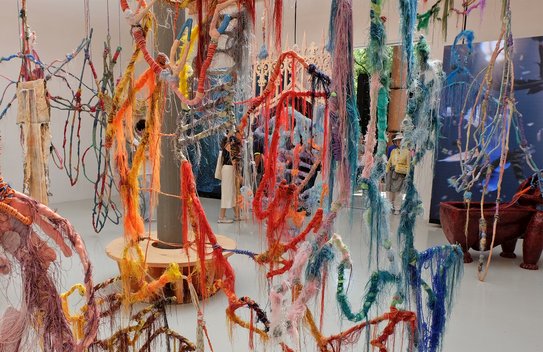
This is symbolized by the freely available exhibition poster, which shows a tarantula on the front and nature-related poems by Julien Creuzet on the back. His total work of art consisting of installations, video walls, sculpture, smells, sounds, music and poetry evokes the sensual experience of nature and its destruction by man. A video animation, in which a sea turtle becomes entangled again and again in a so-called ghost net, is particularly dramatic. Entanglement and disentanglement - the two elements that are linked in many ways - concern both human-environment relations and the aftershocks of colonization. The multimedia pavilion by the Martiniquan-French artist touches on so many sensory and perceptual worlds that a visit lasting several hours is recommended.
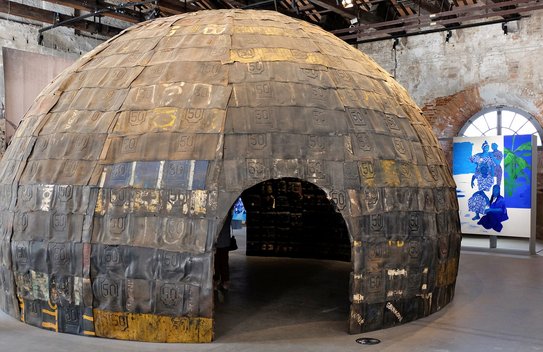
In the national pavilion of Benin in West Africa, these ecological and social themes are complemented by a focus on the vital role of women in maintaining and renewing social unity. The eloquent motto "Everything of value is fragile" culminates in the question of whether this fragility represents a strength or a weakness. The works of artist Moufouli Bello show self-confident women as the backbone of society. At the center of the pavilion is a walk-in round hut by Romuald Hazoumè, built from empty petrol cans, which addresses the ephemeral nature of all existence - of humans, plants and animals - against the backdrop of Yoruba traditions. In the loss of biodiversity, human responsibility for the greater whole is made visible.
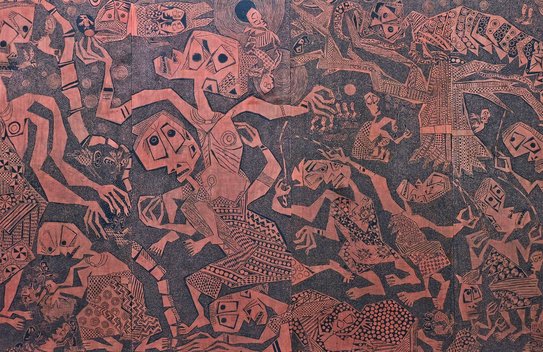
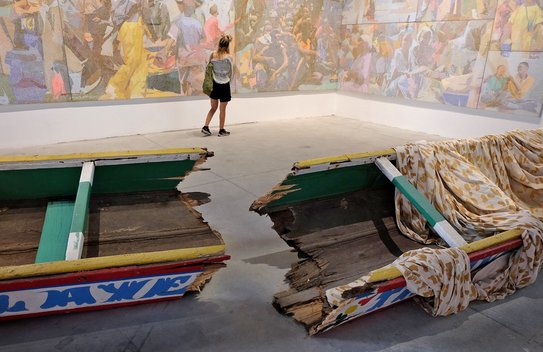
The monumental art of Senegalese artist Aliou Diagne is also about similar relationships. He is exhibiting in his country's pavilion at the Arsenale. In works measuring up to ten by four meters, he uses his unique puzzle-like technique to show how unconscious signs become dynamic paintings of progressive awareness and perception. In the local Wolof language, his project is called Bokk, which means bonds or connections. It appeals to the idea of unity in the face of planetary challenges, particularly as a result of climate change. Viewed up close, his pictures convey an abstract impression; only from a distance do they merge into scenes of everyday life in Senegal. A pirogue that has broken in half lies scattered in front of them. The breakage of this fishing boat used for illegal migration to Europe is ambiguous, suggesting stranded refugees, but also, in a deeper sense, broken dreams and broken promises.
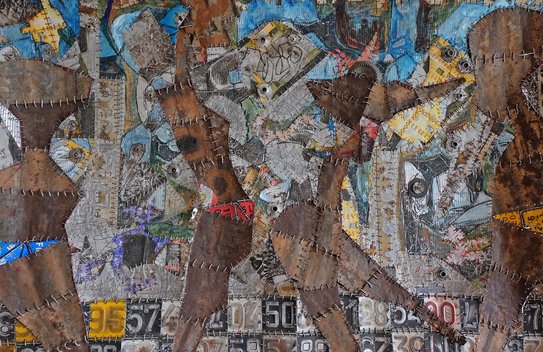
"This Biennale is making a difference," says Tanaka Marawu, the conservator in charge of the Zimbabwe pavilion, "it shows that we in Africa have understood that we need to represent ourselves in order to bring unknown narratives about our communities to the world. We are no longer just passengers on our own ship, we set the course. As narrators of our own story." The fact that this is a story of contact that was anything but equal is summed up by the works of Moffat Takadiwa. His large-scale installations breathe new life into waste products such as old toothbrushes, typewriter keyboards and buttons.
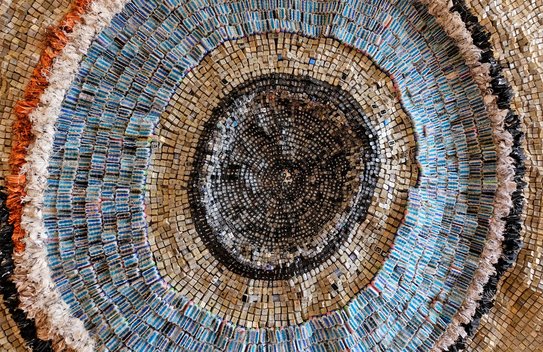
The installation "Land Redistribution", which alludes to Zimbabwe's recent history of land expropriation from white farmers, consists of old buttons and the like. Envelopes are provided in which visitors can take a few buttons as a piece of Zimbabwe. "Africa has become a central dumping ground for the world," says Tanaka Marawu, "but now we are shipping large works of art made from precisely this waste back to Europe. Takadiwa's works are worth up to 200,000 euros, but their real value lies in their contribution to a better and more humane world. This shows how powerful visual art can be in connecting our societies."
More articles
 06/05/2025ScienceMangrove forests
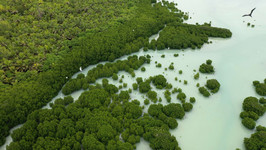
Allies in the fight against climate change
Several initiatives are taking action against the deforestation of mangrove forests in the Seychelles. But how? Angelica V. Marte and Werner Zips found out. 12/10/2024ScienceSustainable corporate culture
Gamechanger men: why equality only works with them
The study "Gender Equality - the role of male managers in transformative corporate culture change" by Linda Suhm calls for a rethink of gender equality. 03/12/2026ScienceGuest article by PD Dr. Martin R. Herbers
Kick-off without a blueprint: What the state election in Baden-Württemberg reveals about the super election year 2026
After the state elections in Baden-Württemberg, the search for the "great lesson" begins. Is it just a revealing prelude or even a blueprint?- 12/16/2025ScienceMobility cooperatives
Better to share than (not) own
Innovation researcher Matthias Weiss talks in an interview about the potential, opportunities and challenges of mobility cooperatives.