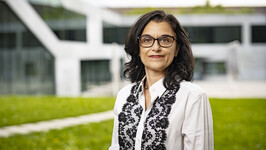
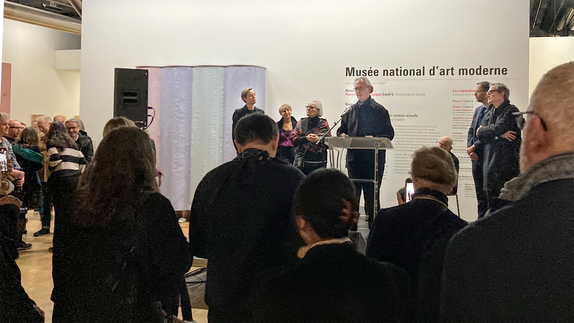
Prof. Schultheis: "Critics now recognize a different side to Bourdieu"
Pierre Bourdieu's photographic work is handed over by the ZU to the Center Pompidou in Paris. Prof. Franz Schultheis has managed the archive for a long time and explains how important it is for understanding the most quoted sociologist.
Professor Schultheis, how did you come into possession of the photographs of the sociologist Pierre Bourdieu?
I had been working as a chercheur associé at Pierre Bourdieu's research center since 1987 and, in addition to joint research, I was responsible for the German-language editions of his works. This also included his Algerian studies, and in our numerous conversations in 1999 Bourdieu mentioned his extensive photo collection from this period for the first time - over 3,000 photographs, which he regarded as a valuable research tool. This visual dimension of his work had remained largely unnoticed in Bourdieu's reception until then.
I persuaded Bourdieu to make these photos available to the public. After some discussion, he agreed and gave me the photos. I traveled to Switzerland with them and began to prepare an exhibition. After a few difficulties, we found partners in Graz and Paris. The exhibition toured worldwide and made Bourdieu's photographic work known to a wide audience.
At Zeppelin University, we continued this work in the context of the artsprogram and organized further exhibitions and publications. In 2023, the Centre Pompidou in Paris finally acquired the physical archive, while the digital archive remains accessible for research purposes as the property of the Fondation Bourdieu.
You have to understand that Bourdieu shot these 3,000 photographs with 35 mm film material, i.e. not digitally. That is a very large number of photographs if you take this into account.
In one of our conversations, Bourdieu told us that at the age of 25, freshly employed as a teacher, he went to Germany especially to buy an Ikoflex camera. During his field research in Algeria during the war of liberation, he used it intensively and took around 3,000 photographs under difficult conditions. Photography was not just a hobby for him, but a systematic part of his field research. He treated each negative with great care and stored them in special paper bags. Although he did not describe himself as a professional or artistic photographer, this effort underlines the importance of photography for his scientific work.
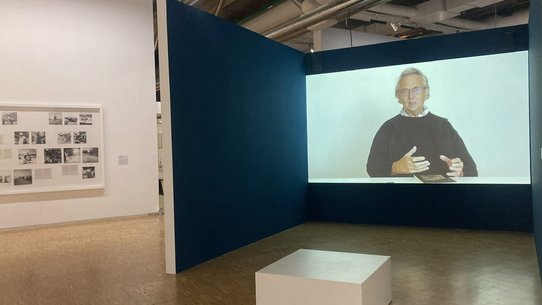
It is obvious what can be seen in a photograph. But what can be read from the photographs or interpreted sociologically?
Bourdieu's photography has many functions. It serves ethnography by visually capturing evidence of other cultures, such as the architecture and interior of a Kabyle house, which can later be analyzed. Bourdieu also used photography to visualize his theoretical concepts, such as "habitus". He attempted to capture the gender-specific habitus photographically by documenting social attributions to men and women and the manifestations of male domination: the man upright and proud, the woman bent over and engaged in less recognized activities.
Bourdieu also recorded the atrocities of the colonial war, not through tanks and battles as usual, but through the forced regrouping of the population. He photographed destroyed houses and documented the uprooting of the people who were driven out of their living spaces. He tried to capture this alienation in the faces of the people by taking many portrait photos. For him, photography was a means of bearing witness and showing people back home in France what was really happening, as the realities of the colonial war remained largely suppressed in France.
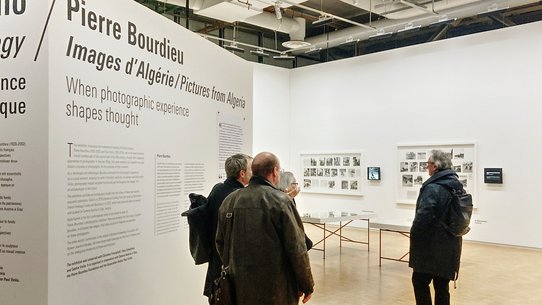
Pierre Bourdieu was several things at once as a photographer
Several functions come together here: that of the journalist, the historian, the chronicler, but above all, of course, that of the sociologist. Was the use of photography widespread in sociology or unique, as in Bourdieu's case?
There are, for example, photographs by Lévy Strauss from his field research in South America and other researchers who recorded the socialization processes in Bali by learning traditional dance in detail. Sociologists such as Ervin Goffman have examined the construction of the social representation of the female gender using advertising photographs. Visual sociology has a long tradition that began 100 years ago in the Chicago School, but later faded into the background as the academization of sociology increased and photography was banned from the repertoire of legitimate research tools and methods.
Bourdieu, however, was an autodidact who never studied social or cultural sciences and acquired sociology himself. Freed from academic rules, he was able to learn in an undisciplined manner, so to speak, and try out many things: Making sketches, examining rites and myths, learning the Kabyle language, analyzing garments and furniture ornaments. This inquisitive and systematic research in Algeria provided him, as he said, with a lifetime's worth of sociological knowledge.
His early research accompanied him until his death. In the mid-1990s, for example, he drew on his photography in his study "La Domination Masculine" and built directly on his earlier observations and their photographic documentation based on his photographic archive.
Do you have any book recommendations for those who would like to delve deeper into the subject?
There is a study called "Bourdieu's Paths into Sociology", which describes his teaching and traveling years in Algeria, but with only a few photographs. At Zeppelin University, together with the late Stephan Egger and Charlotte Hüser, who was still a student at ZU at the time, we published a first book on Bourdieu's photography with Transcript-Verlag. After Egger's death, Hüser took over his position and we put together three more books. One deals with Bourdieu's visual sociology, with a focus on gender relations, another is called "Habitat and Habitus" and examines the significance of housing for the shaping of habitus. The third book, strongly centered on photography, was published by Turia und Kant and is entitled "Conversion of the Gaze" and a new edition of the book "Pierre Bourdie-Images d'Algérie" has just been published by Actes Sud, which I edited together with Christine Frisinghelli from Camera Austria.


Now they are handing over the photographs to the Pompidou Center. What will they do with them?
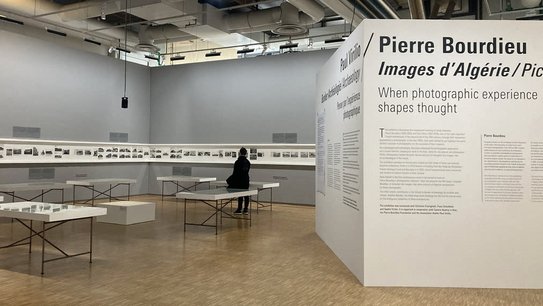
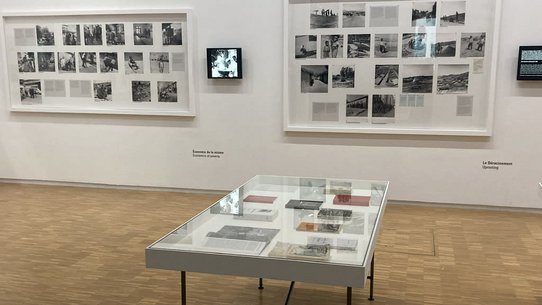
In an exhibition from October 2024 to March 2025, visitors to the Centre will be presented with this photography for the first time in the form of original prints commissioned by Bourdieu himself and contextualized with excerpts from his ethnographic notes and a film by Algerian artist Katia Kameli.
Florian Ebner, Director of Photography at the Centre Pompidou, is strongly committed to the use of photography in the sciences as a documentary method. Bourdieu's photographic archive is to be integrated into the Kandinsky Library, where important physical documents by poets and painters are archived. The Centre Pompidou will be closed for a long time next year for renovations, and this is one of the last exhibitions before it closes.
Also symbolic is the return of Bourdieu's photography to Paris, after being guarded in Switzerland and then intensively researched at Zeppelin University. This marks a return to its original venue and a significant act of cultural heritage.
Bourdieu's photographic work thus also returns to his home country. Why the detours via Switzerland and Germany?
An attentive observer could have noticed long ago that Bourdieu used photography, as several of his books feature photographs from Algeria. Bourdieu himself, however, concealed his authorship and kept his photo archive disorganized in shoe boxes for many years. I worked for many years as a research associate at Bourdieu's Centre de Sociologie Européenne and had a relationship of trust with him. This trust was necessary in order to persuade him to show the photos, because Bourdieu feared that he might be accused of wanting to pose as an artist. In order to clearly mark their scientific status, we never show the photos without text or context.
At the Centre Pompidou, the photos are now presented together with quotes from the field research, which creates a different connotation. We had a similar experience at the Deichtorhallen and the Photographers Gallery in London, where the public nevertheless recognized and acknowledged the aesthetic quality of the images. Bourdieu emphasized that the view through the camera sharpened his sociological eye and helped him to develop new forms of reflexivity in dealing with the observed reality.
What do you think the exhibition can still achieve today?
Bourdieu has been cast in a new light since his photography became known. Critics who were previously rather sceptical of him because of his always very critical stance now recognize a different side to him. As the world's most cited contemporary social scientist, his work has always generated strong competitive effects. But his photography, which is also appreciated by his opponents, shows an empathy and sensitivity that has a calming effect. This long-hidden side of Bourdieu's approach to social reality complements his sociological discourse and lends it a vivid dimension.
Note:
The exhibition was conceived with Christine Frisinghelli, Franz Schultheis and Sophie Virilio. It is being organized in collaboration with Camera Austria in Graz, the Pierre Bourdieu Foundation and the Atelier Paul Virilio association.
The official opening will take place on December 3rd at the Center Pompidou.
Information about the exhibition can be found here.
More articles
 10/14/2026ScienceThe future of multilateralism
“International organizations rarely die—they are hollowed out.”
How the international order is changing amid growing autocratic influence, and whether multilateralism still has a future: An interview with Professor Dr. Maria J. Debre. 09/21/2026ScienceThree Questions for Simon Koschut
Security. Europe. Responsibility.
How Europe's security order is changing, what role transatlantic relations play in this process, and what responsibilities academia and universities bear in a new security landscape. 07/16/2026ScienceThree Questions for Anja Achtziger
More Than Just Studying. Motivating. Making Decisions. Taking Responsibility.
Why Zeppelin University emphasizes judgment, responsibility, and interdisciplinary thinking, and why these skills are more important than ever before.- 06/25/2026ScienceInternational Spring School
Conflict as a Resource for Cultural Policy
Young cultural policy makers from around the world gathered at ZU. They discussed spaces for negotiation within cultural institutions through pluriversal participation and conflict resolution.