Connected from all over the world to answer the question: How can we work together constructively?
People from all over the world take part in the Transcultural Leadership Summit and exchange views on cross-cultural leadership issues. But how are cultural and geographical boundaries overcome online?
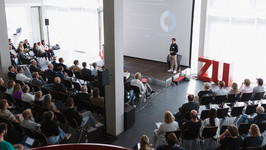
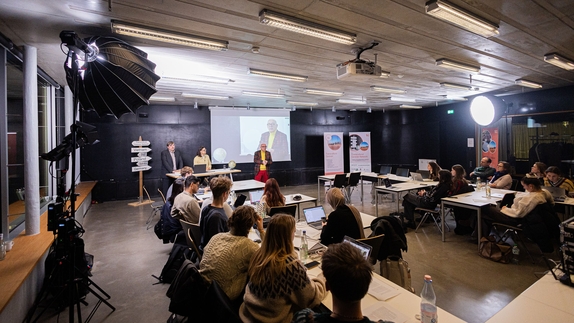
The rows of seats in room 1.06 at Zeppelin University are almost completely full. The moderator stands in front of the "Transcultural Caravan Network" sign in the glow of a light box. Now that the final technical challenges have been overcome, there is a sense of concentrated expectation.
The international collaboration becomes tangible right from the start: Online participants from all over the world actively contribute to solving the initial technical problems. This was a successful start to this year's Transcultural Leadership Summit - a global forum that promotes dialog between cultures and strengthens intercultural connections.
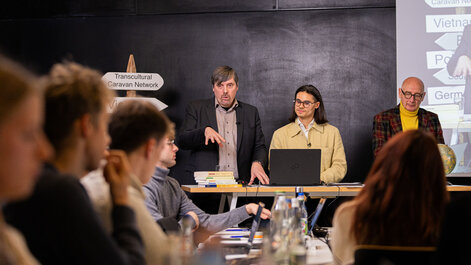
The symposium is one of two World Council events that bring together students and researchers from Zeppelin University and around the world.
Darla Dearhoff, founding president of the World Council, will open the event with an online welcome. "The mission of the World Council is all about connection," she emphasizes. With almost 5,000 colleagues worldwide and over 20 active working groups, the World Council is a unique network of exchange. "Especially in a turbulent world like ours, it is crucial that we focus on our shared values."
The World Council wants to create connections in a fragmented world
An interactive discussion is initiated at the beginning: "What does transculturality mean to you?" The exchange is accompanied by the moderator's words: "This symposium invites us to have deeper conversations and challenge our perspectives. Be open to new ways of thinking - it's a valuable learning opportunity for us all." A Miroboard will help the online community to participate in the conversation.
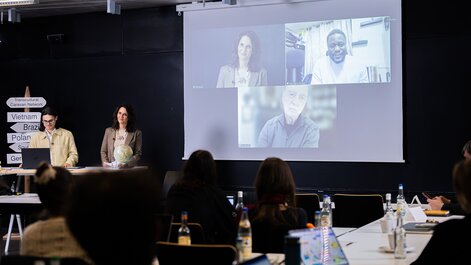
The symposium was organized in cooperation with the World Council on Intercultural and Global Competence. The thematic focus "The Futures of Transculturality - From Education to Leadership" concentrates on the central question: How can we move from the mere recognition of cultural differences to constructive cooperation and shared values?
The future of transculturality: from education to leadership
Professor Josef Wieland, founder of the Transcultural Caravan Network, explains in his opening address that the challenges of transculturality in an increasingly complex world go beyond simple cultural differences. "If we cannot transform parts of our identity - such as habits or beliefs - we will remain trapped in our own little worlds," said Wieland.
The key to creating new communities lies in a willingness to seek new connections together, he said. "We have to have something that connects us as human beings," he emphasizes, "and what we have in common is our experiences - be it in everyday life, in life's challenges or in our metaphysical conception of the world."
Keynote speeches from around the world
Dr. Simon West from Australia gave the first keynote speech of the event entitled "Walking Together in a World of Many Worlds". This demonstrated the diversity that the digital space can provide: Participants from all over the world - from Spain to South Africa to Chile - made the international reach and global network of the Summit impressively tangible.
Bayo Akomolafe, an expert in intercultural communication, explains: "We live in a time when we have to learn to live with disruption." With his words "Brother and Sister", he creates a family atmosphere and emphasizes the need to think of relationships beyond technological bureaucracy. "Every culture is already transcultural - when we see differences as an opportunity to see the world in a new way, true understanding emerges."
Ken Gergen adds to this idea with his critical view of education systems: "There will always be differences - what matters is how we deal with them." Education should not be understood as a standardized evaluation process, but must enable new, inclusive forms of learning.
The short impulses at the end of the event provided further food for thought with topics such as "Navigating Leadership Paradox" by Prof. Dr. Rikke Kristine Nielsen, "In Search of Commonalities" by Dr. Yolande Steenkamp and "Promoting Transcultural Dialogue with Art" by Tião Santos.
A look into the future
The Transcultural Leadership Summit was an opportunity to think outside the box and reflect on many perspectives brought together from different parts of the world. It became clear that it is not just about accepting differences, but rather about seeing them as a starting point for new opportunities. "This was just the beginning of a deep discussion," the moderator summarized. "There is so much food for thought that we need to carry forward."
Who would have thought that such an international atmosphere could unfold in Friedrichshafen at Zeppelin University? The symposium not only opened up global perspectives, but also proved one thing above all: In a fragmented world, there is no greater potential than that of shared experience and mutual learning.
More articles
 08/17/2026LifeInvestor Summit Bodensee
Why Good Ideas Need the Right Connections
For founders seeking funding, the Investor Summit Bodensee is about much more than just a pitch on stage. After all, the most valuable connections are made afterward. 11/24/2025LifeTranscultural Leadership Summit 2025
Global cooperation under pressure: International voices set new priorities for future cooperation
Hanoi, Pretoria, Bucharest. At the Transcultural Leadership Summit 2025, voices from all over the world come together: oppressed by extreme weather, social tensions and democratic crises. The conference shows what challenges we share.- 09/27/2024LifeInvestor Summit Lake Constance
Investors and the public want to know exactly what's going on and put start-ups to the test
At the Investor Summit Bodensee, young start-ups presented their innovative ideas and solutions on the Zeppelin University campus. From artificial intelligence to revolutionary technologies in a wide range of industries, the focus was on ... - 10/08/2026LifeVillage Hub
Starting a business is a matter of practice
This year's Village Hub focuses on the question: If AI makes companies smaller, flatter, and faster—what skills do founders actually still need?