SPD politician Karamba Diaby: a life between discrimination, solidarity and politics
Forty years after his arrival in Germany, Dr. Karamba Diaby, former member of the Bundestag for the SPD, looks back on his journey at Zeppelin University.
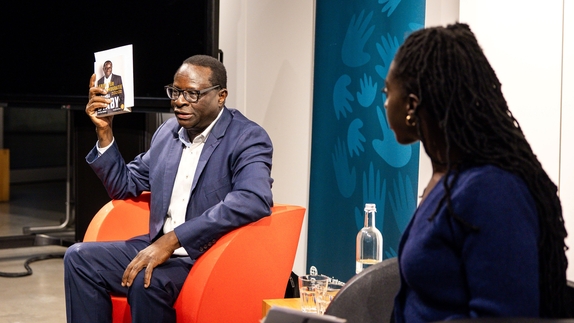
Rhoda Zündorf reads a passage from Dr. Karamba Diaby's book - an anonymous, racist and inhuman letter. Diaby explains to the audience that it is precisely people like this who feel increasingly safe and free with their statements: "It has almost become the norm," says Diaby.
Such hostility mainly reached him via social media, many of which he made public. Although he received criticism as a result, he experienced even more solidarity: "When I receive a death threat, they don't accept it," he says of the people who stood by his side.
He also emphasizes: "Media education is important for political education" - and warns: "Right-wingers think that this free space is a lawless space." He makes it clear that racism also takes place online, but that it is just as much subject to the rules of the constitutional state.
Karamba Diaby was a member of the Bundestag for the SPD
Dr. Karamba Diaby, born in Senegal, was a member of the Bundestag from 2013 to 2025, was committed to international cooperation and human rights, among other things, and received his doctorate in chemistry/biochemistry in Germany.
At Zeppelin University, Diaby is a guest at the Global Talk of the Club of International Politics. He will read a few passages from his book "Leben für die Demokratie: Mein Weg vom Senegal ins deutsche Parlament" and provide insights into his biography. The event will be moderated by Rhoda Zündorf - a student of psychology, economics and politics at Zeppelin University and a member of the Club of International Politics.
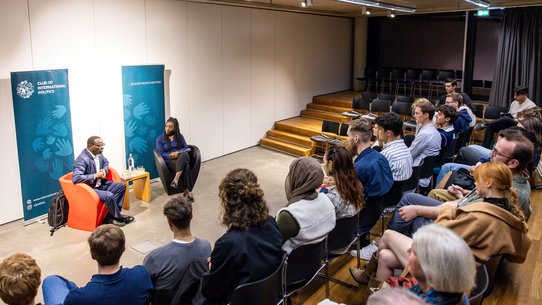
The day of the event is October 2, 2025 - Diaby opens it with the words: "Exactly 40 years ago today, at 3:15 p.m., I came to Germany for the first time." He says he doesn't know where he would be today - 40 years later - if he hadn't found his feet in Germany. And he thanks Zeppelin University warmly for the invitation.
Zündorf asks how his biography came about. Diaby replies: "I didn't know that it was a sensation that I was going into politics." Even after these first words, the audience listens intently. At the time, many people were amazed that a black man was going into politics - many with a migrant background saw Diaby as a role model. He described his identity as "East German plus" - as a citizen of Halle in East Germany with a migration background.
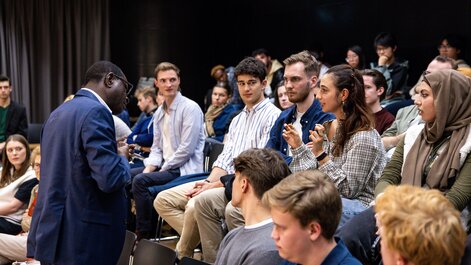
Diaby describes himself as an "East German plus"
An audience member asks why Diaby is doing politics in Germany and not in Senegal. Diaby replies: "Why should I do politics in a country where I haven't lived for 40 years" - "I have contact with my family, but my life is here". These statements only confirm even more how Diaby identifies himself - as an "East German plus".
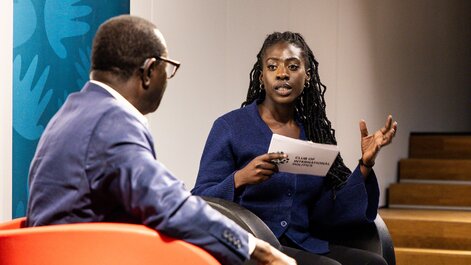
The first passages that Diaby reads from his book are about everyday racism, but also about encounters of solidarity - and should give courage to those who are going through the same thing. In response to Zündorf's question as to why he came to Germany, Diaby talks about his parents who died young, his childhood with his sister and brother-in-law and later with his aunt. He learned about child labor at an early age and spent four years helping in trade. Despite good grades, he didn't get a scholarship - they went to the privileged. That politicized him.
He studied chemistry in Dakar, campaigned for better facilities and became a spokesperson for international students. He first applied to study abroad in Prague, but in the end, chance brought him to Halle with a GDR scholarship. "I knew I had to learn a new language - but I didn't care," said Diaby. His uncle paid for the plane tickets - with the warning: "Don't you dare become a communist." Diaby grins and says: "And what did I become? A social democrat" - the audience laughs.
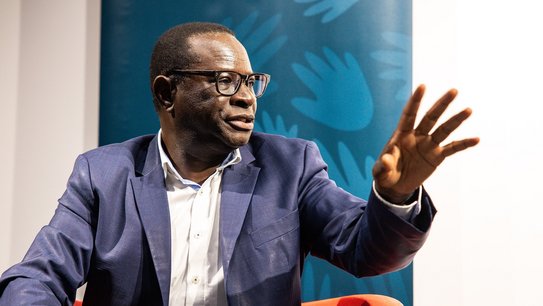
He later joined the Foreigners' Advisory Council in Halle, the Heinrich Böll Foundationwhere he first worked on a voluntary basis and later also on the state board. This also brought him to the attention of the press - and both the SPD and CDU asked him whether he wanted to run for the city council.
Diaby opted for the SPD, with whom he ultimately began his political career. He achieved one of the best results in Saxony-Anhalt and had also received racist comments after his election success. In March 2013 Diaby then became a member of the Bundestag via the Saxony-Anhalt SPD state list . But racism always remained an issue.
More articles
 10/08/2026LifeVillage Hub
Starting a business is a matter of practice
This year's Village Hub focuses on the question: If AI makes companies smaller, flatter, and faster—what skills do founders actually still need?- 09/28/2026LifePhoto Gallery
ZU Summer Festival, themed “Beyond borders.” featuring a diverse program and many guests
Zeppelin University opened its doors and invited anyone interested to meet, exchange ideas, and celebrate together.  08/17/2026LifeInvestor Summit Bodensee
Why Good Ideas Need the Right Connections
For founders seeking funding, the Investor Summit Bodensee is about much more than just a pitch on stage. After all, the most valuable connections are made afterward.- 08/03/2026LifeGlobal Talk with Andreas Kruse
How Young and Old Come Together
In a Global Talk, gerontologist Andreas Kruse explains how the generational conflict can be resolved and how society can be strengthened through interaction and collaboration.